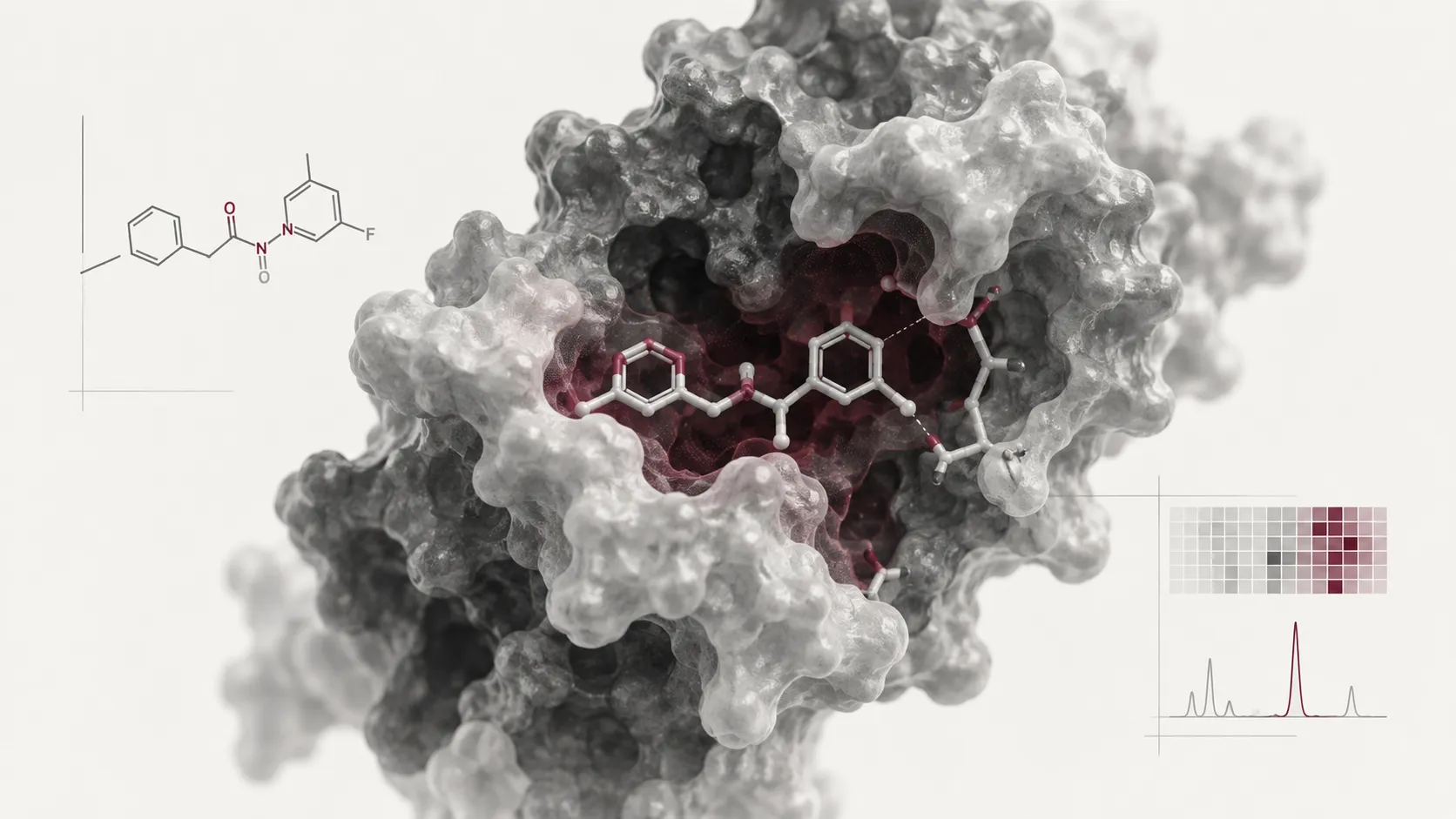
Background & Structural Objectives
Mitragyna speciosa (kratom) produces atypical indole alkaloids that elicit analgesic properties with markedly lower respiratory depression than classical opioids. However, computational investigations often utilize non-isomeric 2D chemical representations that lack authentic stereocenters.
This note documents our automated docking evaluation across human Delta Opioid Receptor (OPRD1, PDB: 6PT3) and Kappa Opioid Receptor (KOR, PDB: 4DJH), comparing unrefined 2D geometries against PubChem Isomeric SMILES.
Key Methodological Insights
Co-crystallized native agonists (DPI-287 on 6PT3) and antagonists (JDTic on 4DJH) achieved crystallographic RMSDs of 1.19 Å and 0.41 Å, well within the strict ≤ 2.0 Å validity threshold.
Transitioning to verified isomeric SMILES with explicit E-alkene geometry and bridgehead chiral centers altered binding postures and resolved key steric clashes.
Isomeric mitragynine formed a direct 3.34 Å contact with catalytic Asp138 on KOR (-7.4 kcal/mol) and 3.37 Å with Asp128 on OPRD1 (-6.5 kcal/mol), mirroring clinical morphinans.
Rhynchophylline exhibited robust affinity for KOR (-7.9 kcal/mol) with a 3.25 Å salt-bridge distance, indicating synergistic target coverage in whole-plant extracts.
Without isomeric stereocenter curation, molecular docking results risk mischaracterizing essential active site hydrogen-bonding networks.
Opioid Reference Benchmarks
Benchmarking our test alkaloids against seven reference agonists and clinical antagonists established physiological consistency:
- Naltrindole (selective DOR antagonist): (KOR) / (OPRD1)
- Morphine (standard opioid agonist): (KOR) / (OPRD1)
- Naloxone (standard opioid antagonist): (KOR) / (OPRD1)
- Mitragynine (isomeric test compound): (KOR) / (OPRD1)
These atomic-level coordinates provide structural rationale for why mitragynine acts as an atypical partial agonist with distinct receptor subtype affinities.