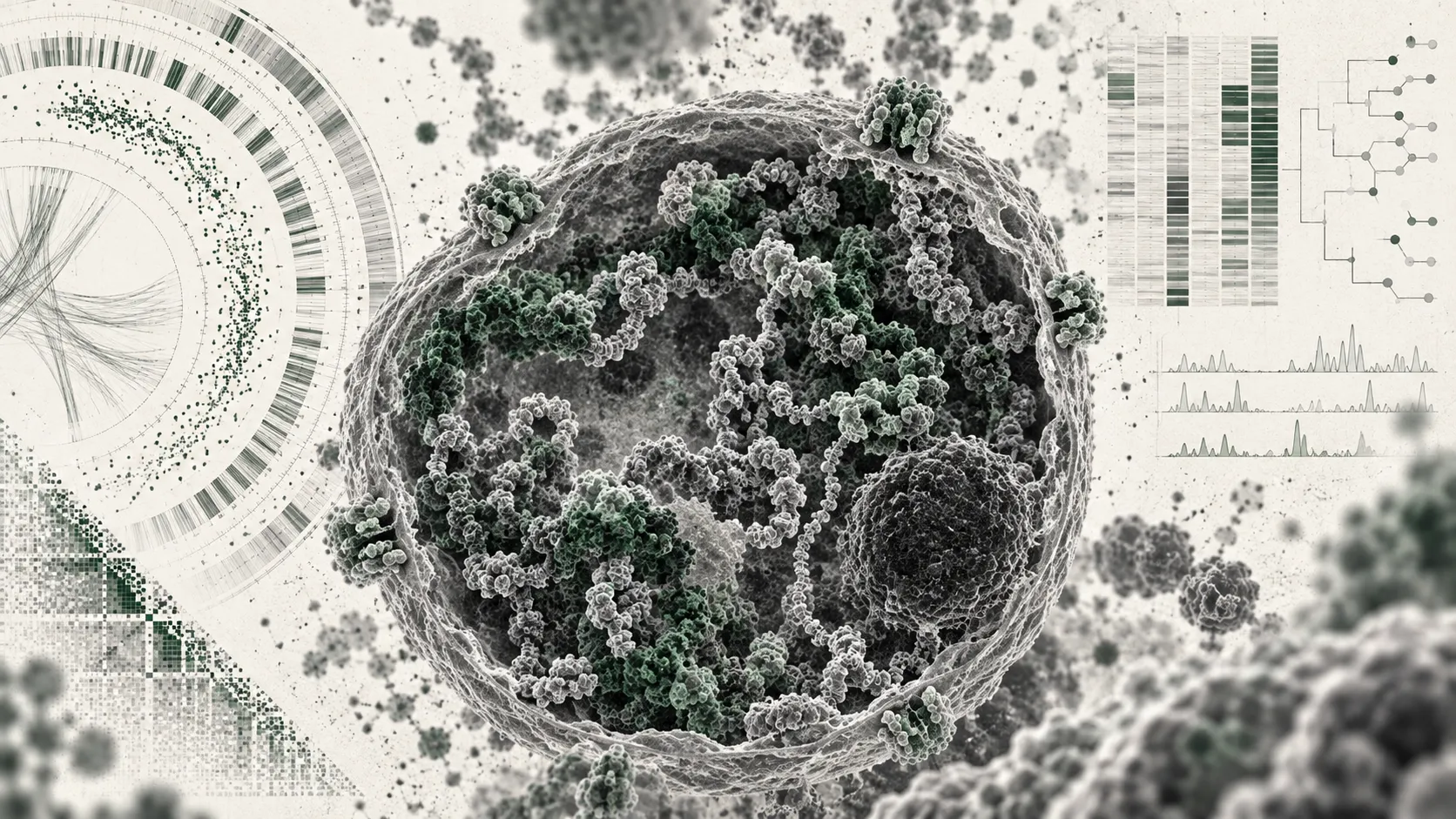
The Nucleosome Barrier
If completely unspooled, the genomic DNA contained within a single human somatic nucleus would measure approximately two meters in length. To fit inside a nuclear envelope measuring mere micrometers across, DNA is wrapped around basic octameric protein cores composed of two copies each of histones H2A, H2B, H3, and H4.
This fundamental packaging unit—the nucleosome—winds roughly 147 base pairs of left-handed superhelical DNA in 1.65 turns around the histone core.
       Nucleosome Architecture
      [ H2A-H2B ] === [ H3-H4 ]
      [  Dimer  ] === [ Tetramer]
             \         /
       ( 147 bp Wrapped DNA )
                 |
      [ Unstructured N-Terminal Tails ] ---> Chemical Modifications
                                              (Me, Ac, Ph, Ub)
While nucleosomal packaging solves the steric condensation challenge, it poses a profound physical obstacle: the nucleosome is an intrinsically repressive barrier. When DNA is wrapped tightly against the histone octamer, promoter motifs (like TATA boxes) and enhancer recognition sequences are sterically occluded from binding by RNA Polymerase II and sequence-specific transcription factors.
The Histone Code: Writers, Readers, and Erasers
To dynamically regulate access to genomic sequences without altering the underlying nucleotide code, cells decorate the unstructured, solvent-exposed N-terminal tails of histones with post-translational modifications (PTMs).
This regulatory system is coordinated by three functional classes of enzymes:
\hline \textbf{Enzymatic Class} & \textbf{Function} & \textbf{Examples} & \textbf{Key Biological Marks} \\ \hline \textbf{Writers} & \text{Deposit PTMs onto residues} & \text{HATs, HMTs, DNMTs} & \text{H3K27ac, H3K4me3, 5mC} \\ \textbf{Erasers} & \text{Catalytically remove PTMs} & \text{HDACs, KDMs, TETs} & \text{Removes Ac or Me marks} \\ \textbf{Readers} & \text{Effector domains that bind PTMs} & \text{Bromodomains, Chromodomains} & \text{Recruits Pol II / Repressors} \\ \hline \end{array}$$ ### 1. Histone Acetylation: Neutralizing Positive Charge Lysine side chains on histone tails carry positive ammonium charges ($-NH_3^+$) at physiological pH, forming strong electrostatic salt bridges with the negatively charged phosphodiester backbone of DNA. When **Histone Acetyltransferases (HATs)** transfer an acetyl group from acetyl-CoA to lysine residues (such as H3K27ac), the positive charge is neutralized. The electrostatic grip loosens, relaxing dense heterochromatin into open **euchromatin** that permits transcription factor engagement. ### 2. Histone Methylation: A Context-Dependent Signaling Flag Unlike acetylation, lysine methylation (mono-, di-, or trimethylation) does not alter electrostatic charge. Instead, it serves as a molecular docking beacon: - **H3K4me3**: Marks transcriptionally active promoters. - **H3K27me3**: Marks facultative heterochromatin and developmental gene silencing. - **H3K9me3**: Marks constitutive, condensed heterochromatin at centromeres and telomeres. --- ## ATP-Dependent Remodelers: The SWI/SNF Engine Histone PTMs alone are insufficient to move nucleosomes; cells require mechanical force. This is executed by multi-subunit **ATP-dependent chromatin remodeling complexes**, categorized into four major families: SWI/SNF (BAF), ISWI, CHD, and INO80. ``` SWI/SNF (BAF) Nucleosome Sliding +---+---+---+ +---+---+---+ ===| N | U | C |=============| N | U | C |=== (Occluded Enhancer) +---+---+---+ +---+---+---+ \ / \===[ ATP Hydrolysis ]==/ (Mechanical DNA Wave Propagation) v +---+---+---+ ===| N | U | C |========================[ Exposed Enhancer ]=== +---+---+---+ ``` Using energy derived from ATP hydrolysis, the central ATPase subunit (such as SMARCA4/BRG1) acts as a molecular translocase. It grips the wrapped DNA strand and introduces transient superhelical loops that propagate around the octamer core like a wave, sliding nucleosomes along the DNA fiber or displacing octamers entirely to uncover buried regulatory motifs. --- ## Epigenetic Memory: Polycomb (PRC2) vs Trithorax During embryonic development, pluripotent stem cells differentiate into hundreds of distinct lineages. Once a liver cell is formed, its progeny must remember to remain liver cells throughout a human lifetime. This cellular memory is maintained by an ancient, conserved epigenetic toggle switch: the **Polycomb (PRC)** and **Trithorax (TrxG)** group complexes. 1. **Polycomb Repressive Complex 2 (PRC2)**: Its catalytic subunit, EZH2, deposits the repressive mark **H3K27me3** across master lineage regulators that must remain silenced in non-target tissues (e.g., silencing neural master genes like *PAX6* in developing hepatocytes). 2. **Trithorax Group (TrxG)**: Antagonizes Polycomb by depositing activating **H3K4me3** marks and recruiting SWI/SNF complexes to keep lineage-appropriate genes open and accessible. --- ## Mitotic Inheritance Through the DNA Replication Fork When a cell undergoes mitosis, the passage of the DNA replication fork displaces all chromatin proteins. How does the newly synthesized daughter strand inherit the epigenetic landscape of the parent cell? 1. **Symmetric DNA Methylation Inheritance**: The enzyme **DNMT1** localizes to the replication machinery. It recognizes hemimethylated CpG dinucleotides where the parental strand carries 5-methylcytosine and rapidly methylates the newly synthesized daughter strand with high fidelity. 2. **Histone Octamer Partitioning**: Parental histone octamers are disassembled into $(H3-H4)_2$ tetramers and $H2A-H2B$ dimers and distributed roughly equally between both daughter DNA strands. 3. **Epigenetic Propagation**: Reader-writer complexes (such as PRC2) bind parental H3K27me3 marks on recycled histones and catalytically deposit identical modifications onto adjacent, newly synthesized naive histones, reconstructing the chromatin landscape across both daughter genomes. --- ## Epigenetic Disruptions in Malignant Transformation Because chromatin regulators control global gene expression, their mutational disruption is a hallmark of human oncology: - **SWI/SNF Mutations**: Inactivating mutations in *ARID1A*, *SMARCA4*, and *SMARCB1* occur in over 20% of all human cancers, particularly malignant rhabdoid tumors and ovarian clear cell carcinomas. - **Oncohistones**: In pediatric glioblastomas, a single point mutation in histone H3 replacing lysine 27 with methionine (**H3K27M**) binds and inhibits EZH2, triggering genome-wide loss of H3K27me3 and locking neural progenitors into an undifferentiated, highly proliferative malignant state. Understanding the mechanics of chromatin remodeling has spurred the development of epigenetic therapeutics—including EZH2 inhibitors, HDAC inhibitors, and bromodomain degraders (PROTACs)—designed to reprogram the diseased epigenome back toward differentiated cellular homeostasis.Further Reading
- Kouzarides, T. Chromatin modifications and their function. Cell 128, 693–705 (2007).
- Margueron and Reinberg. The Polycomb complex PRC2 and its mark in life. Nature 469, 343–349 (2011).
- Clapier and Cairns. The biology of chromatin remodeling complexes. Annu. Rev. Biochem. 78, 273–304 (2009).