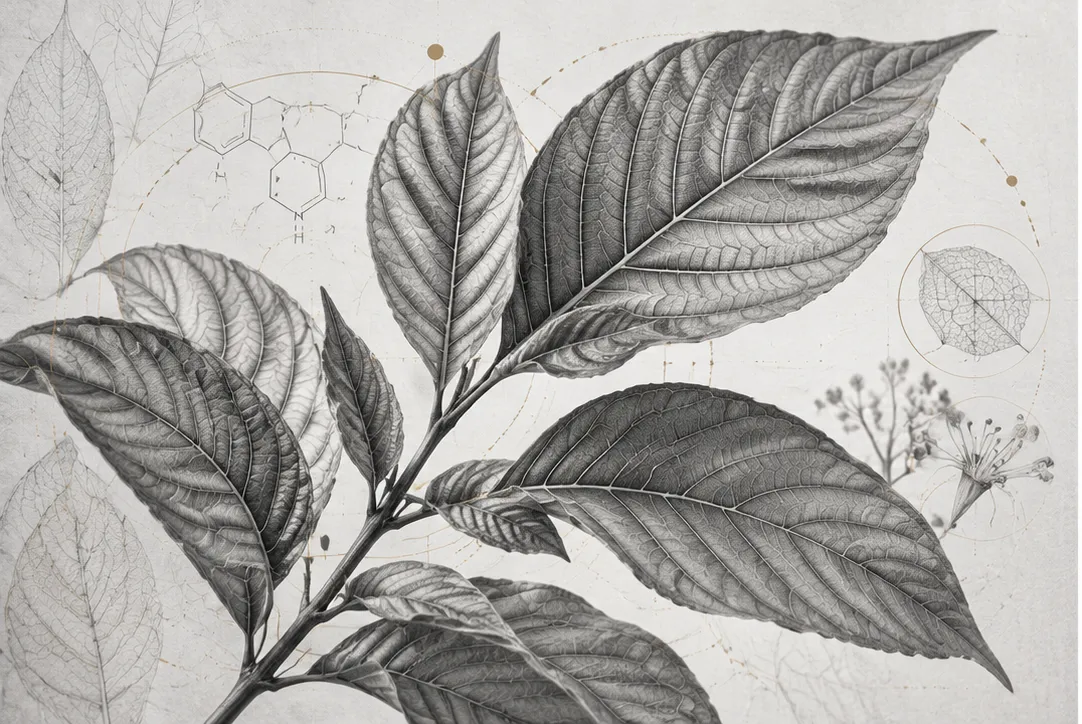
Introduction: Secondary Metabolism in Mitragyna speciosa
Mitragyna speciosa (Korth.) Havil., an indigenous evergreen tree of the family Rubiaceae native to Southeast Asia, synthesizes a complex suite of monoterpenoid indole alkaloids. While traditional medicine has documented the use of its leaves for alleviating fatigue and analgesia for centuries, modern analytical chemistry and structural pharmacology have recently elucidated the molecular mechanisms that distinguish its bioactive constituents from classical morphinan opiates.
Over 40 distinct alkaloids have been isolated and characterized from the plant’s foliar tissues. Among these, mitragynine constitutes up to 66% of total alkaloid content in mature Malaysian and Indonesian specimens, accompanied by lower-abundance structural congeners including 7-hydroxymitragynine, speciociliatine, speciogynine, and paynantheine.
          [Tryptophan]                    [Secologanin]
               │                                │
        (Tryptophan Decarboxylase)              │
               │                                │
          [Tryptamine]                          │
               └──────────────┬─────────────────┘
                              │
                    (Strictosidine Synthase)
                              │
                    [Strictosidine Matrix]
                              │
               ┌──────────────┴──────────────┐
               ▼                             ▼
        [Corynanthe-type]             [Ajmalicine-type]
               │
        [Mitragynine] ──(CYP3A4 oxidation)──> [7-Hydroxymitragynine]
The biosynthesis begins with the stereospecific Pictet-Spengler condensation of tryptamine with secologanin catalyzed by strictosidine synthase (STR), initiating the corynanthe alkaloid scaffold. Subsequent enzymatic oxidations, reductions, and methylation steps yield the unique methoxyindole and acrylate moiety present in mitragynine.
Stereochemical Divergence and Receptor Affinity
The biological activity of Mitragyna alkaloids is rigorously governed by the spatial orientation of asymmetric carbon centers at positions C3, C15, and C20:
| Alkaloid Scaffold | C3 Configuration | C15 Configuration | C20 Configuration | Relative -Opioid Affinity () |
|---|---|---|---|---|
| Mitragynine | -H (trans) | -H | -H | |
| 7-Hydroxymitragynine | Pseudoindoxyl bridge | -H | -H | (High affinity) |
| Speciociliatine | -H (cis) | -H | -H | Moderate () |
| Speciogynine | -H | -H | -H | Minimal binding () |
| Paynantheine | Dehydro at C19-C20 | -H | — | Negligible (-antagonist) |
Mitragynine possesses a trans-quinolizidine ring junction. The open C/D-ring secoiridoid conformation confers flexural freedom not accessible to the rigid pentacyclic structure of morphine. In particular, the C9-methoxy substituent on the indole nucleus anchors the molecule into the hydrophobic pocket between transmembrane helices TM3, TM5, and TM6 of the -opioid receptor (MOR).
Biased Agonism: Escaping the -Arrestin-2 Pathway
Classical morphinan agonists (e.g., morphine, fentanyl) induce receptor conformational rearrangements that recruit both heterotrimeric proteins and -arrestin-2. Arrestin translocation drives receptor internalization, down-regulation, and crucially triggers the intracellular kinase cascades responsible for lethal respiratory depression and gastrointestinal constipation.
In contrast, pharmacological assays demonstrated that mitragynine and 7-hydroxymitragynine act as G-protein-biased agonists:
Ligand Binding at MOR
         │
         ├────────────────────────────────────────────────┐
         ▼                                                ▼
[G_αi/o Signaling]                             [β-Arrestin-2 Pathway]
   │ Inhibits adenylate cyclase                     │ Receptor endocytosis
   │ Activates GIRK potassium channels              │ Arrestin scaffold kinase activation
   ▼                                                ▼
Analgesia / Antinociception                    Respiratory Depression / Tolerance
  (Active with Mitragynine)                      (BLOCKED / Minimally Recruited)
Cryo-electron microscopy structures of MOR bound to mitragynine analogs reveal that the bulky C9-methoxy group clashes sterically with Tyr326, preventing the cytoplasmic helical shift required for deep cleft opening that would otherwise accommodate the arrestin polar core.
Metabolic Transformations: The Role of Hepatic CYP3A4
An essential discovery in Kratom pharmacology is that mitragynine is an active prodrug. In human liver microsomes, mitragynine undergoes cytochrome P450 3A4-mediated oxidation at the C7 position:
Although 7-hydroxymitragynine represents less than 2% of the crude leaf extract, in vivo studies confirm that plasma concentrations of hepatic-generated 7-OH-mitragynine account for the majority of the systemic antinociceptive potency observed after oral ingestion.
Conclusion and Future Directions
The secondary metabolites of Mitragyna speciosa offer a fascinating template for rational structure-based drug design. By decoupling analgesia mediated through coupling from the respiratory side effects driven by -arrestin-2 recruitment, the indole-secoiridoid scaffold proves that nature has already solved one of medicinal chemistry’s most enduring puzzles.
Further Reading
- Kruegel, A. C. et al. Synthetic and receptor signaling explorations of the Mitragyna alkaloids. J. Am. Chem. Soc. 138, 6754–6764 (2016).
- Váradi, A. et al. Mitragynine-derived opioid ligands: Functional selectivity and therapeutic potential. ACS Chem. Neurosci. 7, 1037–1047 (2016).