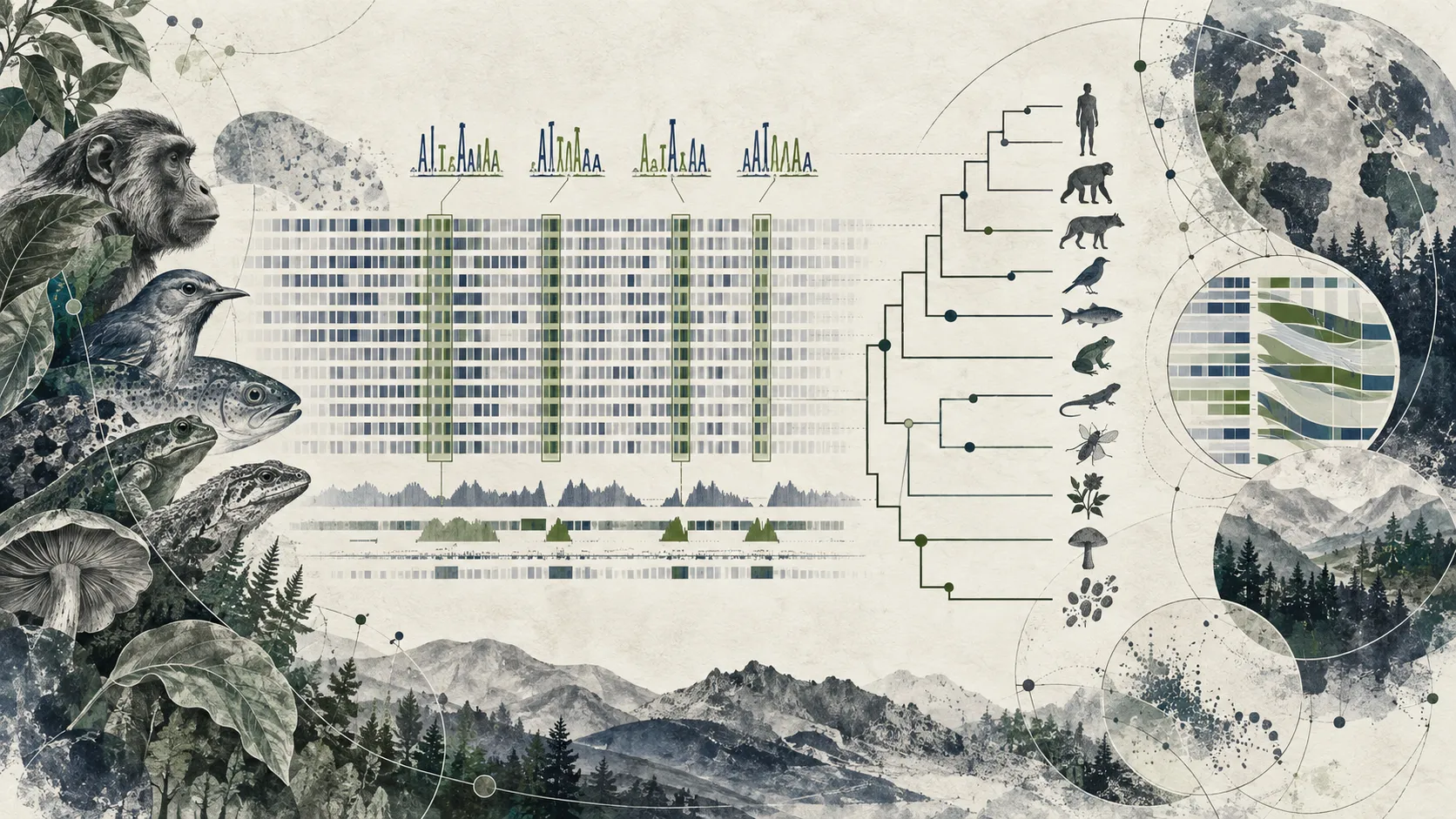
What Is Synteny?
In classic genetics, synteny (from the Greek syn = together, tainia = ribbon) originally described genes residing on the same physical chromosome, regardless of whether they were genetically linked during meiotic crossing-over.
In modern comparative genomics, synteny has taken on a more specific meaning: conserved order and colinearity of homologous genomic loci across divergent species.
When we compare the genomes of two organisms that shared a common ancestor millions of years ago—such as human and chimpanzee (Pan troglodytes), or human and rhesus macaque (Macaca mulatta)—we observe that long blocks containing hundreds of genes remain arranged in identical chromosomal order.
However, interrupting these collinear blocks are sharp evolutionary structural breakpoints caused by translocations, duplications, and large-scale chromosomal inversions.
The Great Ape Karyotype and the Human Chromosome 2 Fusion
The most celebrated chromosomal landmark in human evolutionary genetics is the origin of human chromosome 2.
All non-human great apes (chimpanzees, bonobos, gorillas, and orangutans) possess chromosomes (24 pairs). Anatomically modern humans and archaic hominins (Neanderthals and Denisovans), however, possess chromosomes (23 pairs).
Where did the missing chromosome pair go?
In 1982, cytogenetic banding studies by Yunis and Prakash demonstrated that human chromosome 2 was formed by an end-to-end (telomere-to-telomere) head-to-head fusion of two ancestral ape chromosomes (designated 2A and 2B in chimpanzee):
Chimpanzee Chromosome 2A (p-arm)       Chimpanzee Chromosome 2B (q-arm)
[ Telomere ]===[ Centromere ]===[ Telomere ]   [ Telomere ]===[ Centromere ]===[ Telomere ]
                     \                               /
                      \                             /
                       v                           v
Human Chromosome 2:
[ Telomere ]===[ Active Centromere ]=====[ Inactive Telomere Fusion ]=====[ Vestigial Centromere ]===[ Telomere ]
                                              (2q13 locus)                   (2q21.3-q22.1)
Modern sequencing of human chromosome 2 conclusively confirmed this model at base-pair resolution:
- Internal Inverted Telomeric Hexamer Repeats: At locus
2q13, bioinformaticians identified head-to-head arrays of the canonical vertebrate telomeric repeat and , marking the exact ancestral fusion junction. - Vestigial Inactive Centromere: At locus
2q21.3-q22.1, sequence analysis revealed an array of degenerate alphoid satellite DNA corresponding to the second, silenced ape centromere.
Inversion Dynamics: Pericentric vs Paracentric
Beyond the chromosome 2 fusion, great ape karyotypes are distinguished by numerous large-scale inversions:
- Paracentric Inversions: Inversions confined to a single chromosome arm that do not include the centromere.
- Pericentric Inversions: Inversions where the chromosome breaks on opposite sides of the centromere, inverting the centromeric region and altering the arm ratio ().
Further Reading
- Yunis and Prakash. The origin of man: a chromosomal pictorial legacy. Science 215, 1525–1530 (1982).
- Kehrer-Sawatzki and Cooper. Molecular mechanisms of chromosomal rearrangement during primate evolution. Hum. Genet. 120, 759–792 (2007).
- Kronenberg et al. High-resolution comparative analysis of great ape genomes. Science 360, eaar6343 (2018).