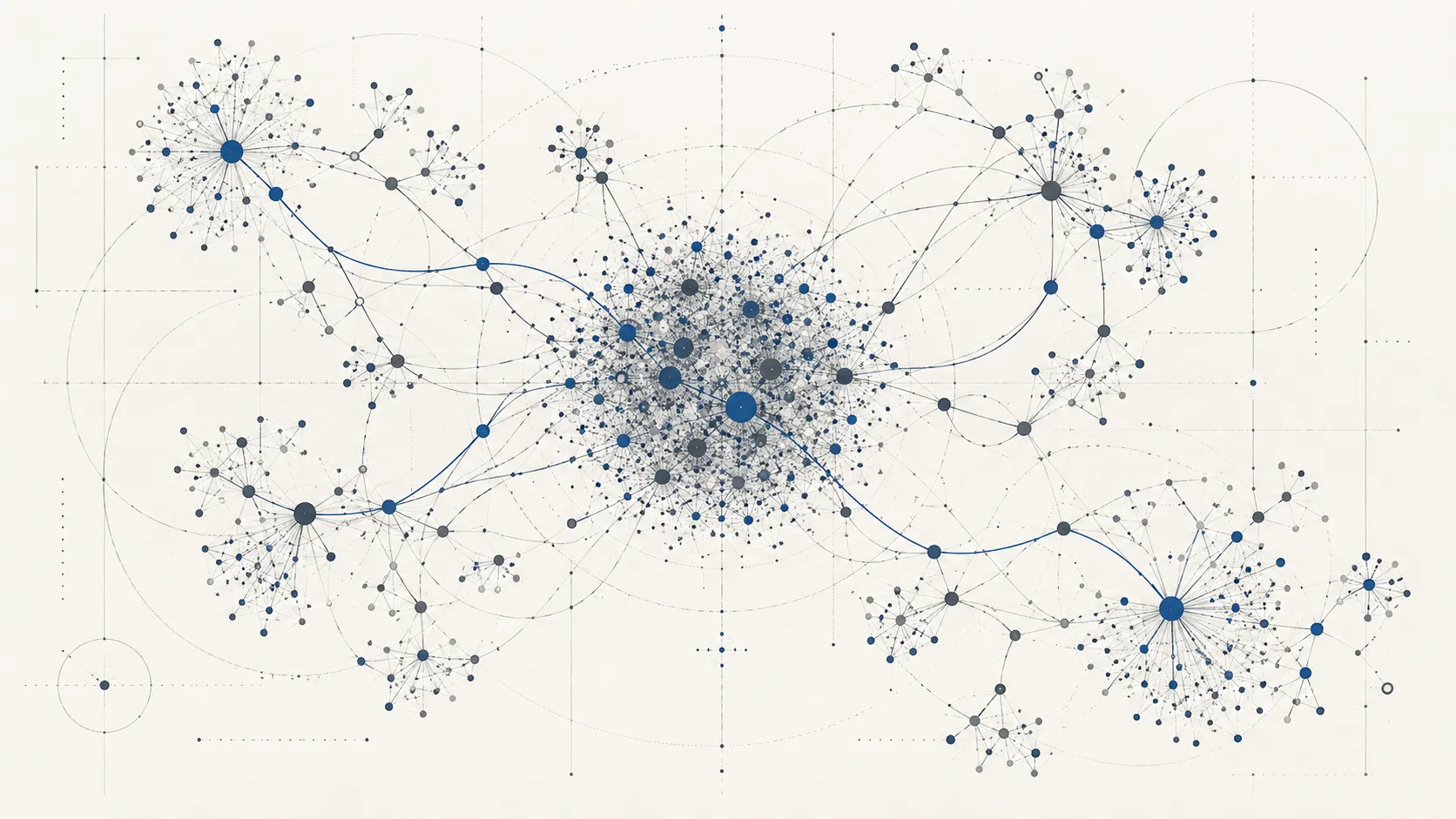
The Cell as a Computational Graph
For over a century, biochemistry focused on identifying individual enzymes, measuring their isolated Michaelis-Menten kinetic constants (), and diagramming linear metabolic arrows. But living cells rarely function as unbranched linear chains.
A bacterial cell coordinates thousands of simultaneous chemical reactions; a human cell integrates external hormonal signals through intricate webs of cross-talking kinases, GTPases, and chromatin remodelers.
In systems biology, cellular organization is modeled as a mathematical graph , where:
- Vertices (Nodes) : Represent molecular entities (genes, proteins, metabolites, microRNAs).
- Edges (Links) : Represent physical or regulatory interactions (protein-protein binding, phosphorylation events, transcriptional activation or repression).
Analyzing the topology of these biological networks reveals mathematical principles that govern cellular homeostasis, evolvability, and systemic disease.
Scale-Free Topologies and Power-Law Degree Distributions
When early mathematicians modeled complex networks (such as the Erdős-Rényi random graph model), they assumed that connections between nodes were distributed randomly. In a random network, node degrees (the number of connections a node possesses) follow a Poisson distribution, meaning most nodes have roughly the same average number of links, with virtually no extreme outliers.
However, empirical mapping of biological networks—including yeast protein-protein interaction (PPI) maps and human transcriptional regulatory networks—revealed a radically different architecture: Scale-Free Networks.
    Random Network (Poisson)            Scale-Free Network (Power Law)
        All nodes ~equal links               Few massive HUBS, many leaves
             o - o - o                             \       |       /
            / \     / \                             o --- HUB --- o
           o - o - o - o                                 / | \
In a scale-free network, the probability that a node has connections follows a Power-Law distribution:
This mathematical relationship means:
- The vast majority of proteins have only one or two interacting partners.
- A small minority of critical proteins—termed Hubs (such as p53, MYC, U泛iquitin, or CDK1)—possess hundreds or thousands of physical connections.
Robustness vs Fragility: The Hub Vulnerability
The power-law topology grants living organisms an extraordinary evolutionary property: error tolerance to random mutations.
If a mutagenic chemical or cosmic ray introduces a nonsense mutation into a randomly selected gene, the statistical probability is overwhelmingly high that the damaged gene is a low-degree peripheral leaf node. The cell survives with minimal phenotypic disruption because the core architecture of the network remains unbroken.
However, this resilience comes with an unavoidable mathematical trade-off: acute vulnerability to targeted attacks on major hubs.
\hline \textbf{Perturbation Type} & \textbf{Random Network} & \textbf{Scale-Free Biological Network} \\ \hline \text{Random Inactivation} & \text{Gradual decay of connectivity} & \text{Extreme robustness (minimal damage)} \\ \text{Targeted Hub Attack} & \text{Gradual decay of connectivity} & \text{Rapid, catastrophic network collapse} \\ \hline \end{array}$$ This duality explains why oncogenic mutations in a handful of master regulatory hubs (e.g., *TP53*, *KRAS*) lead to global cellular transformation, and why pathogens frequently deploy virulence effectors that specifically target conserved eukaryotic host hubs. --- ## Network Motifs: Sign-Sensitive Feed-Forward Loops Beyond global topology, biological networks are composed of recurring subgraphs called **network motifs**—circuits that appear at frequencies significantly higher than expected in randomized graphs (Milo et al., 2002). One of the most biologically critical motifs is the **Coherent Feed-Forward Loop (FFL)**: ``` Transcription Factor X / \ (+) Activates (+) Activates / \ v v Transcription Factor Y --> Target Gene Z (+) Activates ``` In a **Coherent Type-1 FFL with an AND-gate at promoter Z**, Gene $Z$ is only transcribed if **both** Factor $X$ and Factor $Y$ are simultaneously active. ### Why Does Nature Use This Circuit? It functions as a **sign-sensitive noise filter**: - **Transient False Input**: If Factor $X$ undergoes a brief, accidental spike due to thermal or transcriptional noise, Factor $Y$ has not had sufficient time to accumulate. As a result, Target Gene $Z$ remains silent. - **Persistent Real Signal**: Only when Factor $X$ remains active for an extended duration does Factor $Y$ reach its activation threshold, triggering durable transcription of Gene $Z$. This simple three-node circuit allows cells to distinguish genuine physiological signals from ambient biochemical fluctuations. --- ## Applications in Drug Discovery and Polypharmacology Historically, pharmacology sought "magic bullets"—high-affinity compounds that selectively inhibited a single disease-associated target. However, in complex polygenic diseases such as metastatic cancer, type 2 diabetes, and neurodegeneration, single-target therapies often fail due to network robustness: the cell routes signaling flux through parallel compensatory pathways. **Network Pharmacology** shifts the paradigm: 1. **Targeting Multi-Node Cascades**: Designing multi-target compounds (polypharmacology) that exert modest inhibition across several nodes within an oncogenic sub-module simultaneously, overcoming pathway redundancy. 2. **Synthetic Lethality**: Identifying gene pairs ($A$ and $B$) where the loss of either gene alone is viable, but the simultaneous inhibition of both triggers cell death—a strategy famously exemplified by PARP inhibitors in BRCA-deficient tumors. --- ## Conclusion: From Components to Circuits Biology cannot be understood solely by disassembling living organisms into molecular parts lists. Life is an emergent consequence of dynamic network topology—where scale-free connectivity provides evolutionary stability, and compact circuit motifs compute sensory decisions inside every living cell.Further Reading
- Barabási and Oltvai. Network biology: understanding the cell's functional organization. Nat. Rev. Genet. 5, 101–113 (2004).
- Alon, U. An Introduction to Systems Biology: Design Principles of Biological Circuits. CRC Press (2019).
- Milo et al. Network motifs: simple building blocks of complex networks. Science 298, 824–827 (2002).