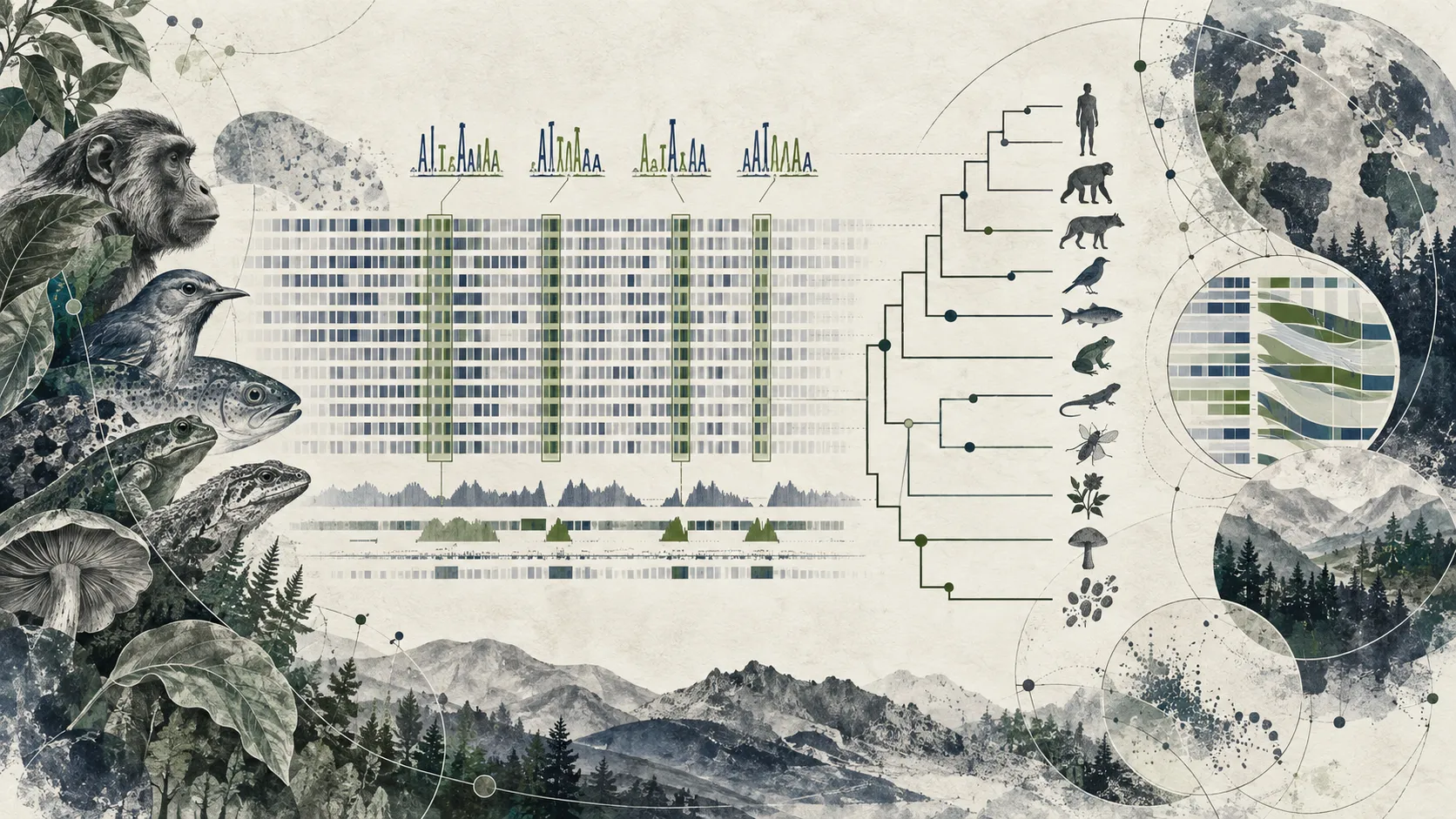
The Mechanics of Phylogenetic Inference
Inferring evolutionary descent from molecular sequences is one of the foundational pillars of bioinformatics. Whether tracing the emergence of a zoonotic coronavirus or mapping horizontal gene transfer of antibiotic resistance cassettes in hospital pathogens, the construction of a phylogenetic tree is a rigorous statistical endeavor.
A common beginner misconception is that phylogenetic trees simply cluster sequences by raw percentage identity. In reality, pairwise distance methods (like UPGMA or Neighbor-Joining) make strong assumptions regarding constant molecular clocks that are routinely violated in real biological systems.
Modern phylogenetic inference relies heavily on Maximum Likelihood (ML) and Bayesian Markov Chain Monte Carlo (MCMC) frameworks, which explicitly model differing rates of nucleotide transition, transversion, and rate heterogeneity across sites.
Multiple Sequence Alignment & Trimming
Every phylogenetic tree is only as reliable as the multiple sequence alignment (MSA) upon which it is computed:
- Alignment Algorithms: High-accuracy tools like
MAFFT(using the--localpair --maxiterate 1000L-INS-i strategy) orMUSCLEshould be favored over legacy heuristic progressive aligners like ClustalW. - Ambiguity Trimming: Poorly aligned regions—such as variable-length loops or non-homologous insertions—introduce phylogenetic noise. Automated trimming tools like
clipKITortrimAlprune systematically uninformative or unalignable positions while preserving genuine phylogenetic signal.
# High-accuracy alignment and signal-preserving trimming
mafft --auto --reorder input_genes.fasta > aligned.fasta
clipkit aligned.fasta -m gappy -o trimmed.fasta
Substitution Models: From JC69 to GTR+G+I
Nucleotides do not mutate with equal probability. Transitions () occur far more frequently in nature than transversions () due to tautomeric shifts and deamination mechanics.
\hline \textbf{Model} & \textbf{Assumptions} & \textbf{Free Parameters} \\ \hline \text{JC69 (Jukes-Cantor)} & \text{Equal base frequencies, equal substitution rates} & 0 \\ \text{K80 (Kimura 2-Parameter)} & \text{Transitions } \neq \text{ Transversions, equal frequencies} & 1 \\ \text{HKY85} & \text{Transitions } \neq \text{ Transversions, unequal frequencies} & 4 \\ \text{GTR (General Time Reversible)} & \text{Variable rate for all 6 pairs, unequal frequencies} & 8 \\ \hline \end{array}$$ Furthermore, some nucleotide positions within a gene are subject to intense purifying selection, while others mutate rapidly. This is modeled using the **Gamma distribution ($+\Gamma$)** with four rate categories, often paired with an invariant site parameter ($+\text{I}$). Modern tools like `IQ-TREE` automatically run **ModelFinder** to evaluate hundreds of substitution matrices against Bayesian Information Criterion (BIC) and Akaike Information Criterion (AIC) scores before computing tree topologies. --- ## Maximum Likelihood & Ultrafast Bootstrapping (UFBoot) Maximum Likelihood evaluates the probability of observing the alignment $D$ given a specific tree topology $T$ and branch length vector $\mathbf{t}$: $$L(T, \mathbf{t}) = P(D \mid T, \mathbf{t}, \mathbf{\theta})$$ The algorithm iteratively searches tree space (using nearest-neighbor interchange [NNI] and subtree pruning and regrafting [SPR] moves) to find the topology that maximizes this likelihood. To quantify branch support, traditional Felsenstein non-parametric bootstrapping repeatedly sampled columns with replacement. However, evaluating 1,000 ML bootstrap replicates on large datasets could require weeks of CPU compute. **Ultrafast Bootstrap (UFBoot2)**, introduced by Minh et al. (2013), computes accurate bootstrap support values in seconds by evaluating likelihood approximations without re-optimizing all branch parameters from scratch: ```bash # IQ-TREE 2: Automated Model Selection + 1000 Ultrafast Bootstraps iqtree2 -s trimmed.fasta -m MFP -B 1000 -T AUTO --prefix my_phylogeny ``` - A branch support value $\ge 95\%$ indicates robust statistical support for that ancestral divergence event. - Support values below $80\%$ should be treated as polytomies (unresolved radiations). --- ## Tree Interpretation & Long-Branch Attraction One of the most insidious artifacts in molecular phylogenetics is **Long-Branch Attraction (LBA)**: ``` True History LBA Artifact +---+ Taxon A (Fast evolving) +---+ Taxon A (Fast evolving) +--| +--| | +---+ Taxon B (Slow evolving) | +---+ Taxon D (Fast evolving) | | | +---+ Taxon C (Slow evolving) | +---+ Taxon B (Slow evolving) +--| +--| +---+ Taxon D (Fast evolving) +---+ Taxon C (Slow evolving) ``` When two unrelated lineages evolve rapidly, random homoplastic mutations accumulate independently in both branches. If an overly simplistic substitution model (like JC69) is applied, the algorithm mistakes these random parallel substitutions for shared derived homologous characters (synapomorphies), falsely clustering the two fast-evolving taxa together. Mitigating LBA requires: 1. Using complex, parameter-rich models ($GTR+\Gamma4$). 2. Breaking long branches by adding intermediate, closely related sister taxa to the sampling matrix. 3. Analyzing amino acid alignments with site-heterogeneous mixture models (such as `CAT-GTR` in PhyloBayes) for deep divergences. --- ## Conclusion: Trees as Testable Hypotheses A phylogenetic tree is not an infallible historical transcript; it is an analytical hypothesis. By adhering to rigorous alignment curation, principled model selection, and defensive interpretation of bootstrap support, computational biologists can reconstruct the ancestral past with statistical confidence and reproducible precision.Further Reading
- Felsenstein, J. Evolutionary trees from DNA sequences: a maximum likelihood approach. J. Mol. Evol. 17, 368–376 (1981).
- Nguyen et al. IQ-TREE: a fast and effective stochastic algorithm for estimating maximum-likelihood phylogenies. Mol. Biol. Evol. 32, 268–274 (2015).
- Minh et al. Ultrafast approximation for phylogenetic bootstrap. Mol. Biol. Evol. 30, 1188–1195 (2013).