Scale-Down Photobioreactor: Kinetic Modeling & Real-Time Monitoring
Hardware integration, telemetry, and automated kinetic parameter estimation for micro-scale photobioreactors to standardize carbon fixation rate metrics.
THE QUESTION
How can scale-down mini-photobioreactor systems minimize spatial gradient artifacts and optical noise to achieve high-precision kinetic estimation for carbon fixation rates?
BACKGROUND
Estimating biological carbon fixation rates in conventional benchtop and pilot photobioreactors is frequently compromised by spatial light attenuation and non-uniform dissolved gas gradients. This project implements a miniaturized, sensor-integrated scale-down photobioreactor framework that couples real-time optical density logging, calibrated fluidic agitation, and secure remote telemetry for reproducible parameter benchmarking.
APPROACH OVERVIEW
HARDWARE & SENSOR INTEGRATION
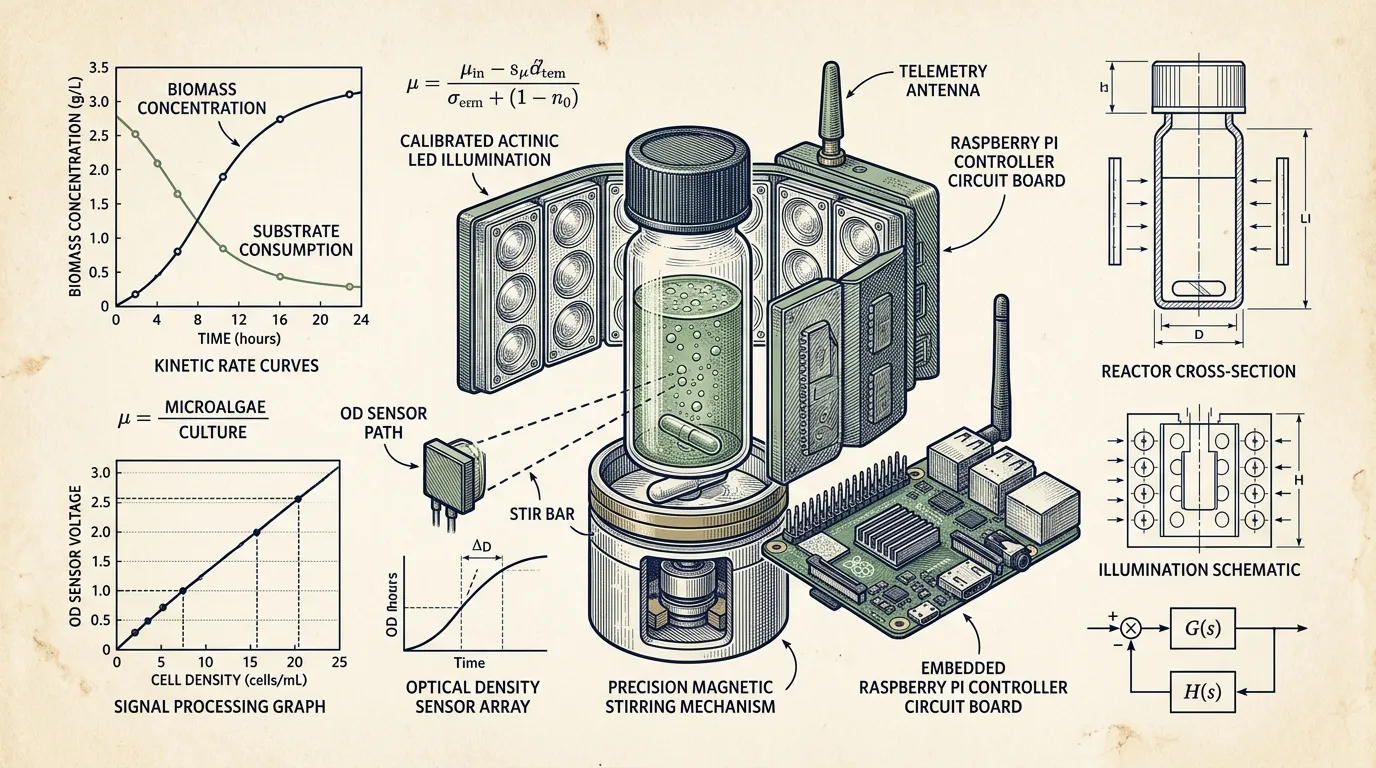
Assembly of embedded controller architecture (HAT expansion), multi-angle photodiode arrays (90°/135°), and actinic illumination modules.
DRY-RUN HARDWARE VERIFICATION
Systematic verification of PWM driver signals, closed-loop PID thermal response, and sensor telemetry across baseline states.
HYDRODYNAMIC STABILITY BENCHMARK
Empirical optimization of micro-magnetic stirring regimes (100–800 RPM) to prevent vortex optical interference and de-coupling.
SECURE LAB TELEMETRY & NETWORKING
Dual-tier network routing establishing isolated static local IP addressing alongside peer-to-peer encrypted mesh VPN for remote logging.
KINETIC ESTIMATION & NOISE FILTERING
Signal processing model mapping calibrated photodiode raw voltage to continuous biomass accumulation and carbon uptake metrics.
METHODS
- •Scale-Down Architecture: Modular micro-vial platform (15–20 mL) designed to eliminate self-shading and hydrostatic pressure gradients.
- •Optical Density Sensing: Dual-angle light scattering array (90° and 135°) calibrated to decouple true cellular turbidity from hydrodynamic swirl artifacts.
- •Thermal & Agitation Control: Pulse-width modulated magnetic drive paired with PID-tuned resistance heating elements maintaining temperature stability within ±0.2°C.
- •Robust Lab Telemetry: Static IP binding on local institutional Wi-Fi coupled with tailscale overlay networking for zero-trust remote telemetry and SSH console access.
- •Kinetic Estimation Framework: Real-time logging of specific growth rate () to compute instantaneous carbon fixation capacity without destructive physical sampling.
KEY DATA SNAPSHOT
RESULTS
The integrated scale-down framework demonstrated that calibrating micro-magnetic agitation to 450–500 RPM effectively prevents optical beam disruption while maintaining homogeneous suspension, enabling reliable continuous kinetic tracking.
DISCUSSION
Miniaturizing cultivation volume to micro-scale effectively bypasses light dilution gradients that distort growth kinetics in large-scale columns.
Stirring speeds exceeding 750 RPM introduce micro-bubble cavitation and surface vortexing that confound photodiode baseline signals.
Dual-tier networking (local static IP combined with mesh overlay) enables robust multi-user lab access while securing long-duration unattended runs.
LIMITATIONS
- •Kinetic models derived in scale-down micro-chambers require empirical scaling-up correction factors for macro-scale hydrodynamic shear.
- •Photodiode sensor calibration curves must be established individually for distinct microbial cell morphologies.
- •Continuous long-term runs require strict evaporation mitigation protocols in micro-volume configurations.
IMPACT & APPLICATION
DATA & REPRODUCIBILITY
Analytical code and specific target coordinates are currently held under institutional review and confidential protocol.
REFERENCES
- 01Acién, F. G. et al. (2012). Photobioreactors for the production of microalgae. Reviews in Environmental Science and Bio/Technology.
- 02Takache, H. et al. (2010). Experimental and theoretical kinetic analysis of microalgae growth in photobioreactors. Biotechnology and Bioengineering.
- 03Pioreactor Project. (2023). Open-source hardware platform for continuous microbial cultivation.