ARG Evolution in Klebsiella pneumoniae: A Phylogenetic & Selection Study
Phylogenetic analysis, selection pressure modeling, and horizontal gene transfer tracking of critical antibiotic resistance genes in clinical Klebsiella pneumoniae.

THE QUESTION
How do clinical antibiotic resistance genes in Klebsiella pneumoniae evolve under global selective pressures, and what role does horizontal gene transfer play in their dissemination?
BACKGROUND
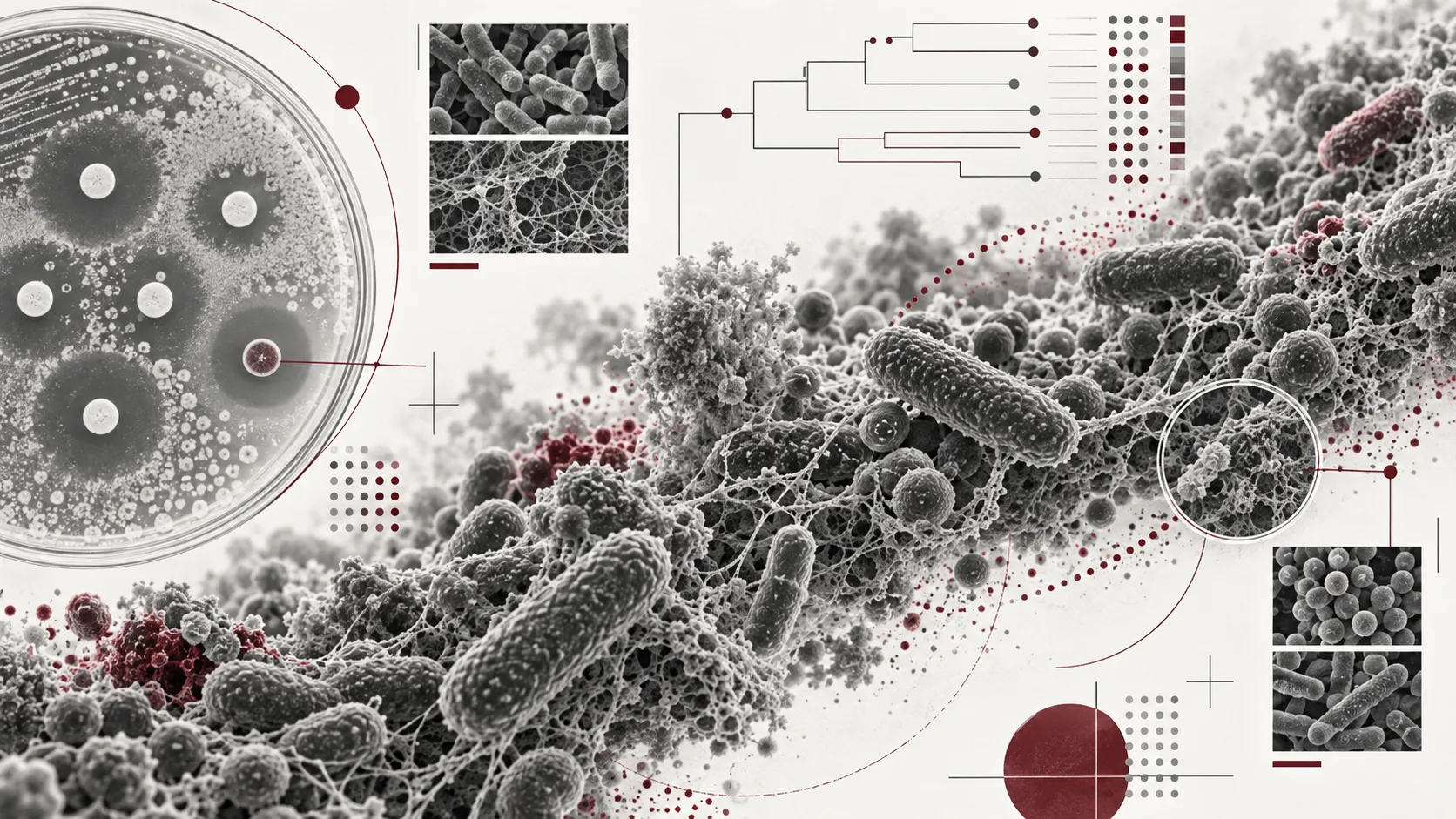
Klebsiella pneumoniae is recognized by the World Health Organization as a top-tier critical priority pathogen due to rampant multidrug resistance and rapid acquisition of extended-spectrum beta-lactamases (ESBLs) and carbapenemases. This research explores the evolutionary dynamics, lineage conservation, and codon-level selection pressures across clinical ARG repertoires.
APPROACH OVERVIEW
GENOME INGESTION & ANNOTATION
Automated retrieval of complete Klebsiella genomes from NCBI GenBank, executing ABRicate against the CARD database for ARG profiling.
MULTIPLE SEQUENCE ALIGNMENT
High-accuracy codon and amino acid alignments for target resistance genes (blaCTX-M, blaTEM, blaSHV, oqxAB) using MAFFT.
MAXIMUM-LIKELIHOOD PHYLOGENETICS
Constructing robust phylogenies with IQ-TREE using ModelFinder substitution model optimization and ultrafast bootstrap support.
SELECTION PRESSURE PROFILING
Evaluating dN/dS ratios and site-level positive or purifying selection via HyPhy and Datamonkey models.
MGE & GENOMIC ISLAND PREDICTION
Detecting horizontal gene transfer signatures and genomic island integration via AlienHunter and IslandViewer.
METHODS
- •Genomic Cohort: High-quality complete and draft Klebsiella pneumoniae assemblies retrieved from NCBI GenBank and SRA.
- •ARG Identification: Curated homology matching against CARD (Comprehensive Antibiotic Resistance Database) and ResFinder.
- •Phylogenetic Inference: Maximum Likelihood trees parameterized using IQ-TREE with 1,000 ultrafast bootstrap replicates.
- •Evolutionary Selection: Codon-level dN/dS estimation using SLAC, FEL, and MEME models on the Datamonkey platform.
- •Genomic Context: Flanking sequence parsing to differentiate chromosomal integrons from transmissible plasmid cassettes.
KEY DATA SNAPSHOT
RESULTS
Phylogenetic reconstruction revealed that carbapenemase and ESBL determinants cluster into distinct global clonal lineages, with over 80% showing direct association with plasmid-borne mobile genetic elements. CTX-M-15 remains the dominant disseminated allele, exhibiting pronounced purifying selection across catalytic active site residues.
DISCUSSION
Phylogenetic clustering confirms that high-risk clones (e.g., ST258, ST307) serve as super-spreaders of multi-drug resistance determinants.
Strong purifying selection across the beta-lactamase catalytic pocket ensures catalytic fidelity while peripheral residues adapt to host immunological pressures.
The predominant plasmid localization of carbapenemases highlights the urgency of monitoring horizontal gene transfer networks beyond vertical chromosomal inheritance.
LIMITATIONS
- •Public repository sequence data exhibits geographic sampling bias, overrepresenting regions with dense genomic surveillance infrastructure.
- •Short-read assembly fragmentation can complicate exact plasmid assembly without long-read hybrid scaffolding.
IMPACT & APPLICATION
DATA & REPRODUCIBILITY
Analytical code and specific target coordinates are currently held under institutional review and confidential protocol.
REFERENCES
- 01Wyres, K. L. & Holt, K. E. (2018). Klebsiella pneumoniae as a key trafficker of antimicrobial resistance genes. Current Opinion in Microbiology, 45, 131–137.
- 02Nguyen, L. T. et al. (2015). IQ-TREE: a fast and effective stochastic algorithm for estimating maximum-likelihood phylogenies. Molecular Biology and Evolution, 32(1), 268–274.
- 03Alcock, B. P. et al. (2023). CARD 2023: expanded curation, support for machine learning, and resistome prediction at the Comprehensive Antibiotic Resistance Database. Nucleic Acids Research, 51(D1), D690–D699.