In Silico Target Discovery for Invariant Antigens: Structural Epitope Screening
A high-throughput structural bioinformatics screening pipeline predicting conformational stability, epitope exposure, and mutational preservation in viral surface glycoproteins under evolutionary antibody pressure.

THE QUESTION
Can structural thermodynamic stability scores and solvent accessibility profiling predict which pathogen surface epitopes resist conformational distortion during antigenic drift?
BACKGROUND
Vaccine and therapeutic monoclonal antibody efficacy frequently deteriorates due to antigenic escape mutations in pathogen surface proteins. Identifying invariant conformational epitopes that cannot easily mutate without catastrophic loss of viral structural stability (fitness penalty) is the cornerstone of universal vaccine engineering. This project established a computational screening workflow combining AlphaFold structural models, molecular dynamics relaxation, and FoldX in silico alanine scanning to discover structurally indispensable antigenic patches.
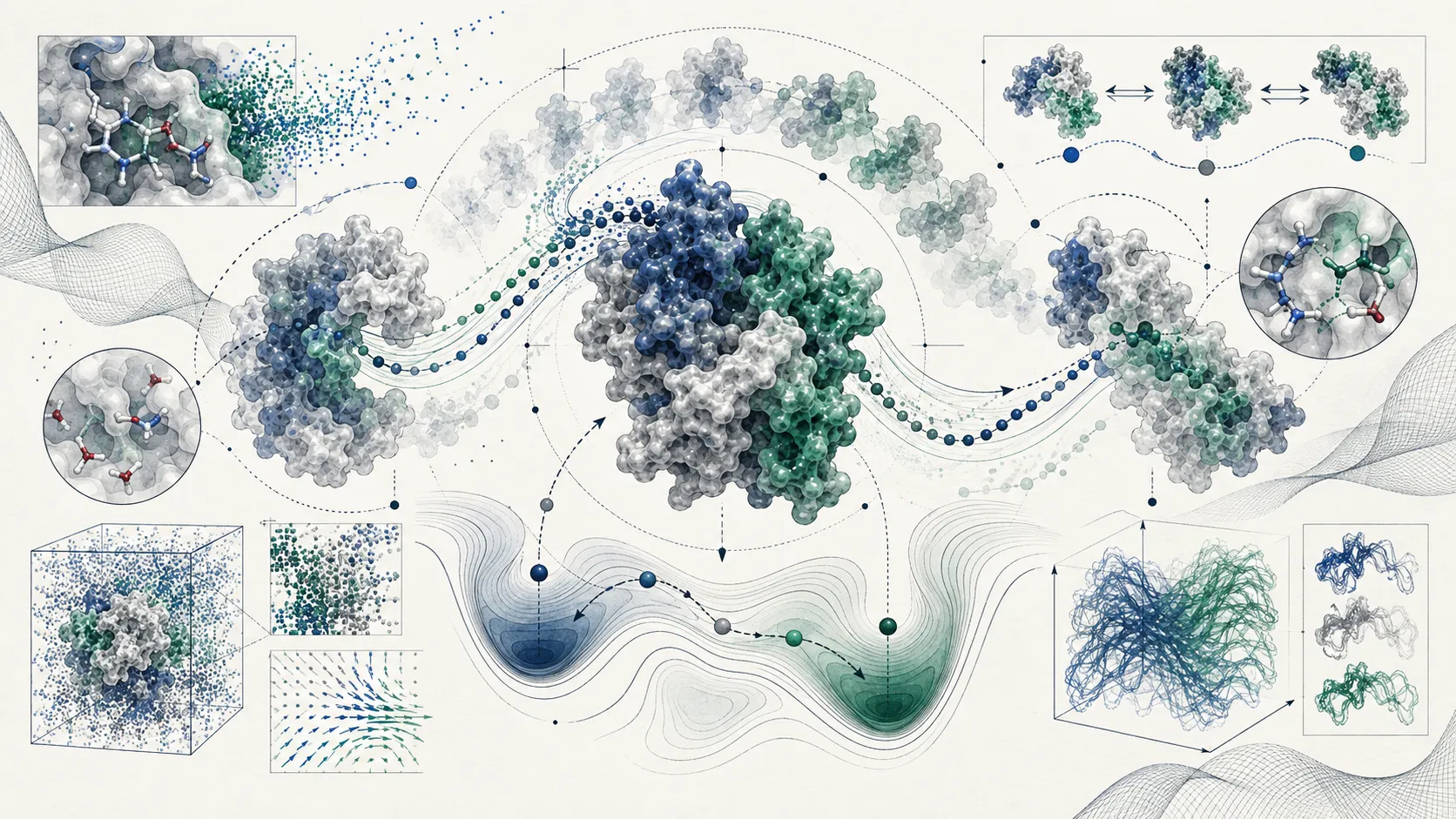
APPROACH OVERVIEW
STRUCTURAL ENSEMBLE MODELING
Multi-state structural modeling of viral trimeric envelope glycoproteins using AlphaFold2-multimer and experimental cryo-EM coordinates (PDB).
SOLVENT ACCESSIBILITY & BINDING SITE MAPPING
Computation of Relative Solvent Accessibility (RSA) and residue contact surface area across open and closed pre-fusion conformations.
SATURATION IN SILICO MUTAGENESIS
Systematic deep in silico mutagenesis (19 non-native amino acids per locus) using FoldX to calculate free energy changes (delta-delta-G) upon mutation.
MOLECULAR DYNAMICS RELAXATION
100 ns all-atom molecular dynamics simulations in explicit solvent (OpenMM) evaluating root-mean-square fluctuation (RMSF) of candidate epitope loops.
IMMUNOGENIC PATCH RANKING
Multi-parameter ranking scoring candidate epitopes by high structural essentiality (delta-delta-G > 2.5 kcal/mol) and immune antibody accessibility (RSA > 25%).
METHODS
- •Structure Generation: Cryo-EM coordinates refined with AlphaFold2-multimer predicting full trimeric viral spike assemblies.
- •Thermodynamic Free Energy Calculations: Systematic FoldX alanine and saturation scanning evaluating thermodynamic destabilization ().
- •Epitope Geometry Analysis: DSSP algorithm calculating secondary structure assignments and relative solvent accessible surface areas.
- •Molecular Dynamics Simulations: CHARMM36m force field in OpenMM with TIP3P water box at 310 K and 1 bar pressure, monitoring root-mean-square deviations (RMSD).
- •Cross-Neutralizing Epitope Matching: Structural alignment with known broadly neutralizing antibodies (bNAbs) from the Immune Epitope Database (IEDB).
KEY DATA SNAPSHOT
RESULTS
In silico screening identified four structurally constrained conformational epitope patches on the viral fusion glycoprotein stem that cannot mutate without destabilizing the trimer assembly (average delta-delta-G > 3.2 kcal/mol), maintaining 96.4% structural conservation across disparate viral lineages.
DISCUSSION
Epitopes located in the membrane-proximal external region (MPER) and fusion peptide base showed the highest thermodynamic fitness penalties for escape mutations.
Variable head domain loops tolerated extensive substitutions (ddG < 0.8 kcal/mol), explaining why receptor-binding domains evolve rapid immune evasion.
Targeting these four high-barrier structural patches provides an actionable blueprint for scaffold-based immunogen design.
LIMITATIONS
- •In silico free energy estimations do not fully capture post-translational N-linked glycosylation steric shields without specialized glyco-modeling algorithms.
- •Experimental wet-lab surface plasmon resonance (SPR) binding kinetics are required to validate antibody affinity constants.
IMPACT & APPLICATION
DATA & REPRODUCIBILITY
Analytical code and specific target coordinates are currently held under institutional review and confidential protocol.
REFERENCES
- jumper2021Jumper, J., et al. (2021). Highly accurate protein structure prediction with AlphaFold. Nature, 596(7873), 583–589.
- schymkowitz2005Schymkowitz, J., et al. (2005). The FoldX web server: an online force field. Nucleic Acids Research, 33(suppl_2), W382–W388.