
Introduction
Every cell in your body carries the same genetic information, yet different cells look and behave differently. How does this happen? The answer lies in gene expression — the process by which cells read the information in DNA and turn it into functional products, such as proteins.
Gene expression is one of the most fundamental processes in biology. It bridges the gap between what a genome can potentially do and what a cell actually does. In this article, we'll walk through the basics of gene expression in a simple and visual way, without getting too deep into technical details.
Why Does Gene Expression Matter?
Gene expression is essential for almost everything in biology — from development and growth to metabolism, immunity, and even disease. When gene expression goes wrong, it can lead to conditions such as cancer, genetic disorders, or infections.
Gene expression describes the process by which information in DNA is used to produce RNA and proteins, which then carry out the cell's functions.
The Basic Process
Gene expression happens in two main stages: transcription and translation.
Transcription
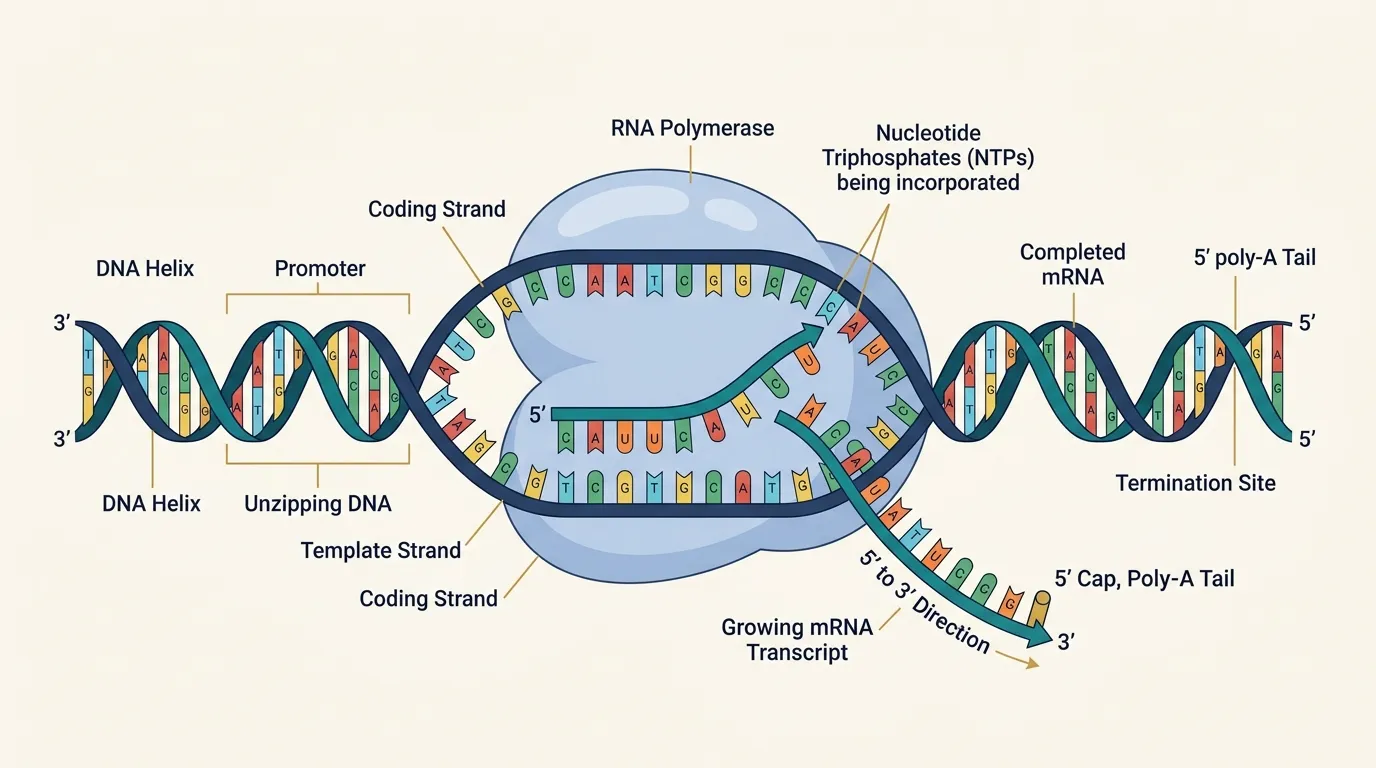
The first step is transcription, where a segment of DNA is copied into messenger RNA (mRNA). This happens in the nucleus (in eukaryotes) with the help of an enzyme called RNA polymerase.
Translation
Next, the mRNA travels to the cytoplasm, where ribosomes read the sequence and build a chain of amino acids — forming a functional protein.
Key Players
To understand how gene expression operates smoothly inside a living system, several molecular entities coordinate with remarkable fidelity:
- DNA (Deoxyribonucleic Acid): The permanent master archive safely stored inside the nucleus, encoding instructions with four chemical bases (A, T, C, G).
- RNA Polymerase: The enzymatic machine that binds to a promoter, unwinds the double helix, and builds a complementary RNA transcript.
- mRNA (Messenger RNA): The transient messenger carrying a specific genetic recipe from the nucleus to the cellular manufacturing floor.
- Ribosome: The macromolecular factory that translates mRNA triplets (codons) into linear polypeptide chains.
- tRNA (Transfer RNA): Molecular adaptors that shuttle specific amino acids matching each mRNA codon.
A Simple Analogy
Think of your genome as an entire encyclopedic cookbook kept safely inside a protected reference library (the nucleus). You wouldn't take the heavy, irreplaceable original volume into a bustling, messy kitchen.
Instead, you photocopy just the one specific recipe page you need for dinner (transcription into mRNA). You take that lightweight printout out to the kitchen counter (ribosome), where the cooks gather the individual fresh ingredients (amino acids brought by tRNA) and assemble them in the exact order specified by the recipe to create the completed, delicious dish (the functional protein).
Takeaways
- Cell Identity: Even though nearly all cells in an organism share an identical genome, gene regulation dictates whether a cell behaves as a neuron, muscle fiber, or immune cell.
- Direction of Information: Genetic information flows in a conserved direction: DNA → RNA → Protein (the Central Dogma of Molecular Biology).
- Dynamic Control: Cells continuously tune gene expression levels in response to nutrients, temperature, signals from neighboring cells, and environmental stressors.
Further Reading
- Alberts et al. Molecular Biology of the Cell (7th ed.).
- Campbell Biology (12th ed.).
- Nature Reviews Molecular Cell Biology (open access).