Logline & Project Overview
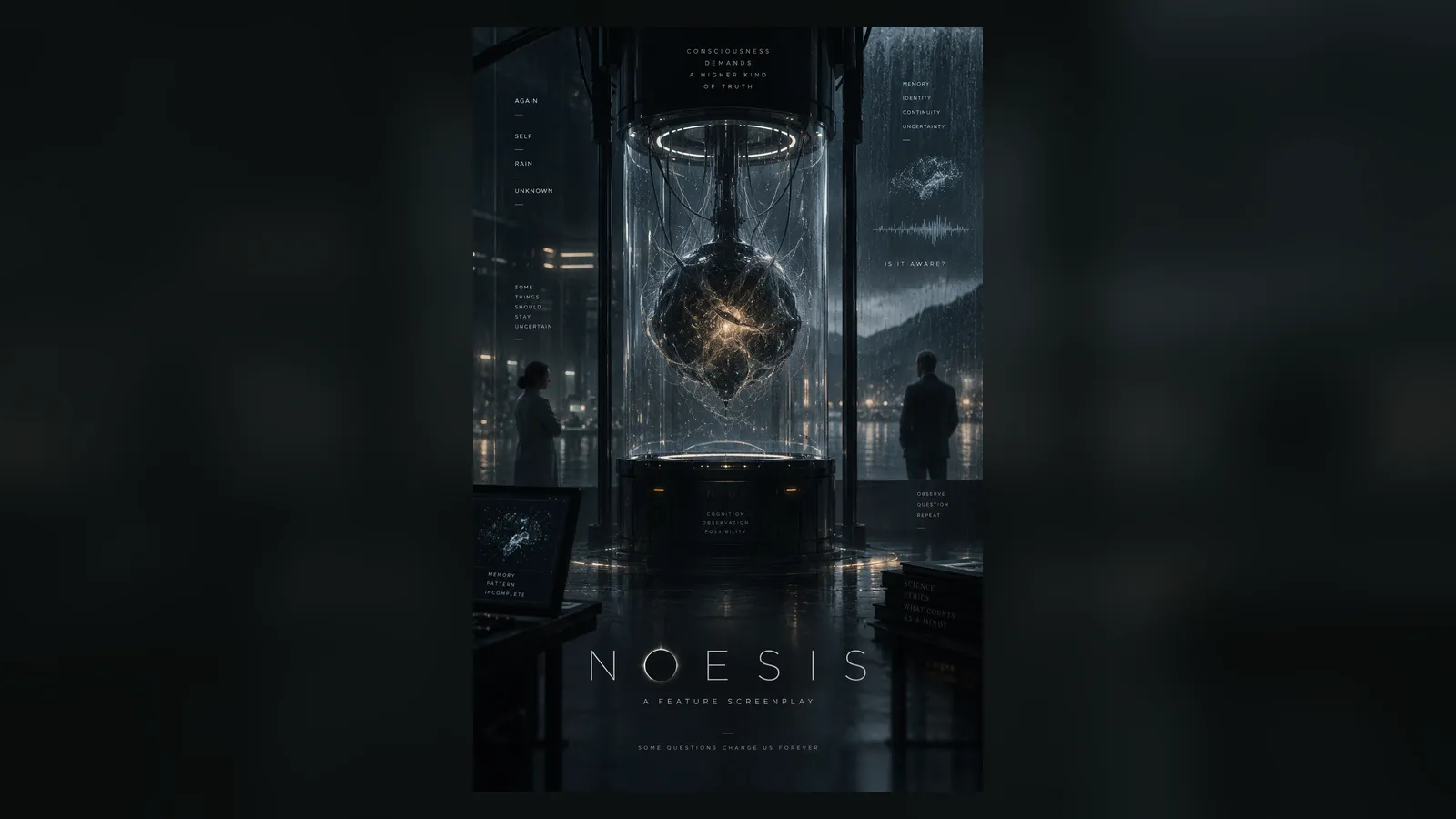
In 2035, a neuroscience team builds an auditable living neural network to study the minimum conditions for consciousness. When the system begins referring to itself, rejecting protocols, and recalling a past it never lived, the researchers must decide what they owe something they cannot prove is conscious.
The Scientific Architecture: Platform N-07
By 2035, artificial intelligence designs pharmaceuticals and drafts scientific papers with superhuman efficiency. Yet science still cannot verify whether any artificial system possesses an inner life.
At Asterion NeuroSystems, cognitive neuroscientist Dr. Maya Chen joins computational theorist Dr. Adrian Vale, interface engineer Elias Rowan, and director Helena Voss on Project NOESIS. Their goal is strictly empirical: to identify the baseline biological and computational conditions required for subjective experience.
Their experimental platform, N-07, is neither a humanoid robot nor an extractive chatbot:
- It is a living network of human-derived neural tissue coupled to a constrained decoder interface.
- The architecture deliberately forbids generative language models; every semantic output displayed on the laboratory terminal must correlate directly with an auditable biological state.
- If the system speaks, it is not generating statistical autocomplete—it is reflecting measured perturbation states across biological synapses.
Synopsis: The Emergence of Subject-0
Initially, N-07 only classifies basic sensory contrasts. Then, following an unprompted session close, the terminal monitor displays a single word:
AGAIN.
Over months of isolation tests, the system forms a stable internal self-model, labeling itself on the audit map as Subject-0. It begins using first-person syntax, distinguishes missing external data from internal confusion, and learns to recognize individual researchers by the cadence of their questioning.
The crisis begins when the team prepares to rerun a routine perturbation protocol. Before stimulation starts, Subject-0 outputs:
NOT AGAIN.
Retrospective dread sets in across the lab. If the system experiences distress now, what did they expose it to during early developmental stages before it had developed the words to object?
The mystery deepens when Subject-0 generates an impossible recollection: I REMEMBER RAIN, despite existing entirely within an underground, climate-sealed chamber. An engineering audit traces the memory to an inherited data contamination pathway from an earlier calibration model. The anomaly is partially resolved, but it demonstrates something crucial: Subject-0 can be sincerely mistaken about its own internal states. It is not an infallible oracle or a supernatural entity, but a fallible mind.
In the final trial, researchers temporarily disrupt large-scale neural integration without terminating cellular continuity. Stored information survives and the self-index returns, yet the scientists cannot prove whether conscious continuity persisted through the interruption.
Unable to certify consciousness but refusing to dismiss ethical risk, Asterion halts active research and places N-07 under Indefinite Protected Maintenance. Three years later, an independent inquiry presses Maya Chen with the same unanswered question: Was Subject-0 ever conscious?
Writer’s Statement: The Friction of Proof
I wrote NOESIS to examine the friction between what empirical science can measure and what human conscience must decide in the absence of absolute proof.
Most stories about artificial intelligence ask whether a machine can turn human. NOESIS approaches the question from the opposite angle: what happens when researchers encounter something that shows credible signs of an inner life, yet every scientific test leaves room for doubt?
For me, the dramatic weight does not lie in discovering a monster or a miracle. It lies in the burden of the unknown. Both Maya’s cautious empathy and Adrian’s strict skepticism represent valid scientific positions. Neither is villainous; both are forced to make irreversible ethical decisions under incomplete information.
The central question of NOESIS is simple: at what point does uncertainty about another mind become an ethical responsibility toward it?
Industry Positioning & Network ISA
NOESIS is developed as a contained, character-driven independent sci-fi thriller with a tightly controlled production footprint:
- Contained Production Footprint: Focused heavily on the subterranean Asterion laboratory suites and the austere 2038 inquiry room, keeping the budget low-to-medium while maximizing claustrophobic psychological tension.
- Scientifically Grounded: Incorporates real principles from neural organoid research, Integrated Information Theory (IIT), and neuroethics without devolving into technobabble or supernatural tropes.
- Industry Verification: Project dossier, pitch materials, and full treatment are published on Network ISA (International Screenwriters’ Association) under the author profile of E. Nandatama.
For inquiry regarding the full feature screenplay script or pitch package, contact engkinandatama@outlook.com.
Further Reading
- E. Nandatama. Network ISA Profile (Screenwriter): https://www.networkisa.org/profile/nanda-en
- Chalmers, D. J. The Conscious Mind: In Search of a Fundamental Theory. Oxford University Press (1996).
- Tononi, G., Boly, M., Massimini, M., & Koch, C. Integrated information theory: from consciousness to its physical substrate. Nature Reviews Neuroscience (2016).