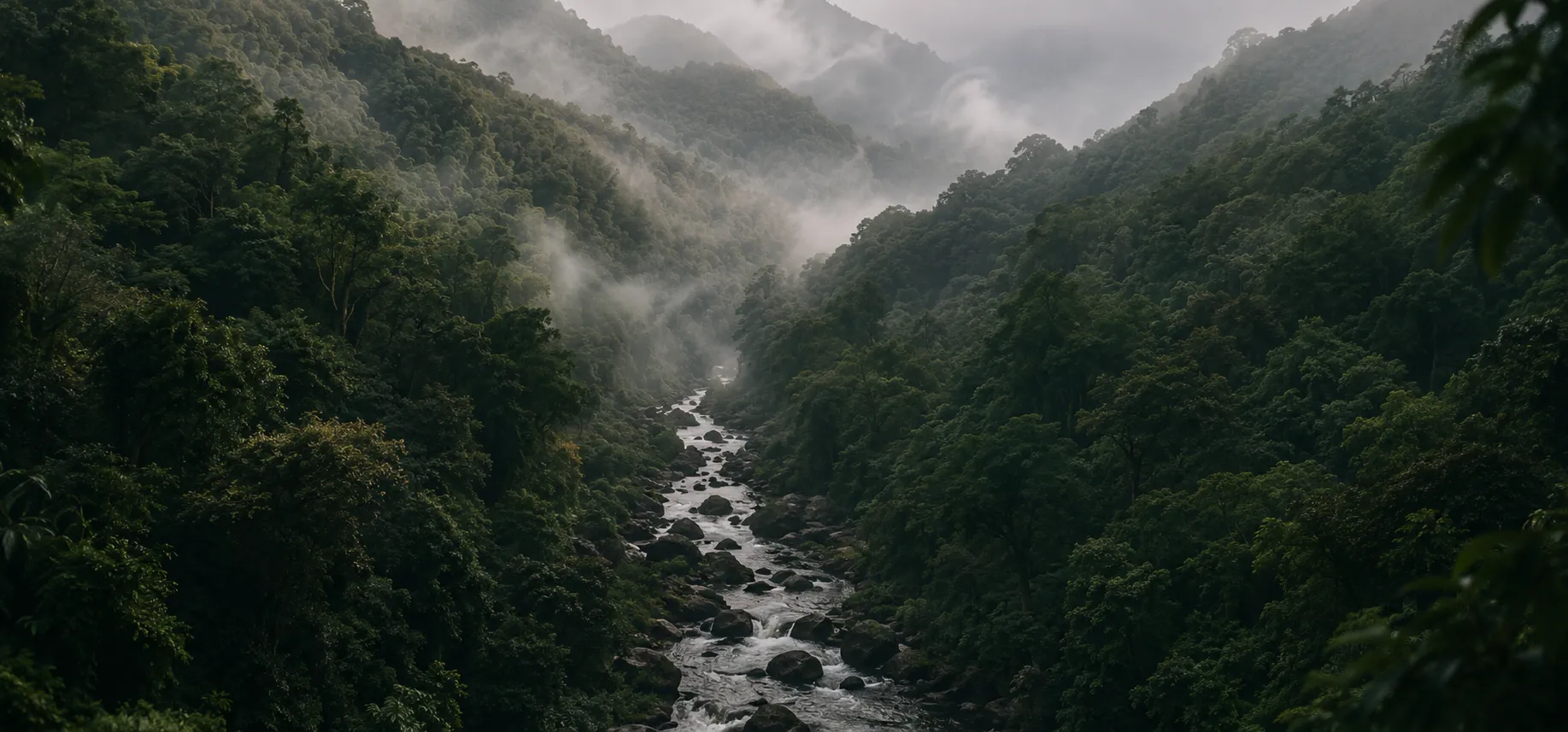
The Pre-Dawn Cacophony
At 4:45 AM, forty meters above the forest floor on an aluminum observation tower in Gunung Halimun Salak National Park, the world is monochrome indigo. The fog hangs motionless, saturating the leaves of emergent Altingia excelsa trees.
Then, a single high-frequency whistle cuts through the humid air—the Javan whistling thrush (Myophonus caeruleus). Within ninety seconds, the silence is shattered as thousands of birds, insects, and gibbons awaken in a tightly synchronized explosion of sound known to acoustic ecologists as the dawn chorus.
 Figure 1: Time-frequency STFT spectrogram demonstrating acoustic niche partitioning in tropical wet canopy (Cicada broadband stridulation, thrush FM syllables, and gibbon harmonic calls).
The Acoustic Niche Hypothesis
Why does this wall of sound not collapse into an unintelligible mess?
In 1987, bioacoustician Bernie Krause formulated the Acoustic Niche Hypothesis (ANH). Just as species in an ecosystem divide physical resources—some foraging in the leaf litter, others in the high canopy—vocalizing species partition the acoustic spectrum:
- Spectral Partitioning: Each species communicates within a distinct frequency band. The deep, chest-resonant calls of the Javan gibbon (Hylobates moloch) occupy frequencies below , allowing their long-wavelength sounds to travel kilometers through dense foliage without scattering.
- Temporal Partitioning: Smaller passerines with higher-pitched songs () time their vocal bursts between the periodic stridulations of cicadas.
- Information Integrity: By avoiding overlap in frequency and time, the signal-to-noise ratio () remains high enough for potential mates and territorial rivals to decode the message across hundreds of meters:
From Parabolic Reflectors to Autonomous Recorders
Field ornithology has shifted dramatically over the past decade. Where researchers once spent weeks in blind hides with heavy parabolic microphones, we now deploy autonomous acoustic recording units (ARUs) strapped to mossy trunks.
These small weatherproof sensors record continuously on high-capacity SD cards for months at a time, capturing terabytes of raw .wav audio. Back in the laboratory, we run Fourier transforms:
converting the humid dawn of West Java into vibrant mathematical spectrograms. Through these visual soundscapes, we can monitor endangered bird populations, detect illegal logging chainsaws in real-time, and quantify biodiversity without setting a single mist net.
Yet when you sit high on the observation platform with the cold mist brushing your cheek, the mathematics fades. You are simply a quiet witness to an ancient evolutionary symphony that has played out above this island long before human ears were here to listen.
Further Reading
- Krause, B. The Great Animal Orchestra: Finding the Origins of Music in the World's Wild Places. Little, Brown (2012).
- Sueur, J. Sound Analysis and Synthesis with R. Springer (2018).