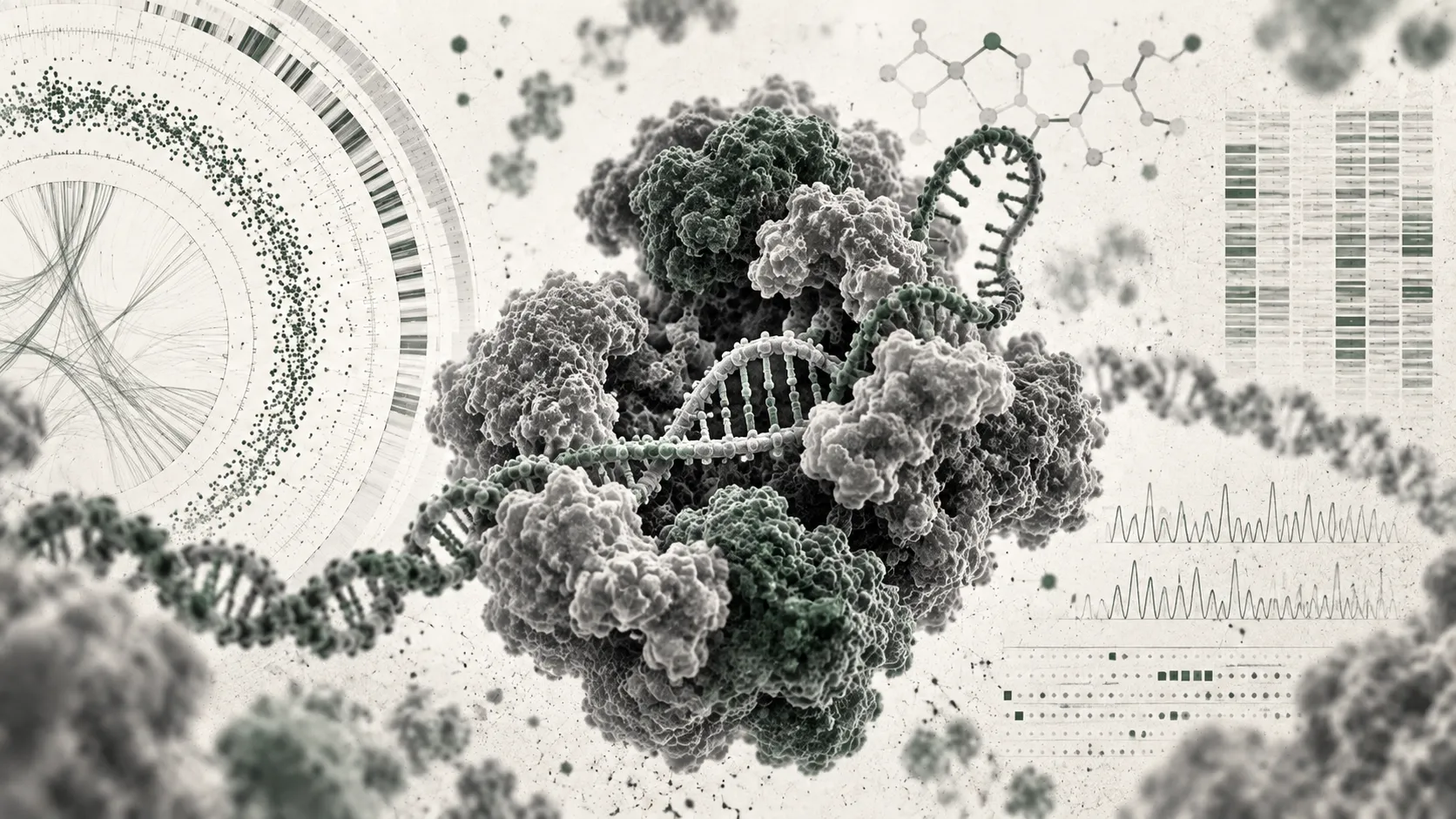
The Problem with the Scissors Analogy
Popular science outlets almost universally introduce CRISPR-Cas9 as “molecular scissors.” While evocative, this metaphor actively misleads researchers regarding the true biochemical and computational bottlenecks of precision genome editing.
Scissors cut indiscriminately through whatever is placed between their blades. CRISPR-Cas9, by contrast, is a dynamic ribonucleoprotein complex governed by rigorous thermodynamic kinetics, conformational checkpoints, and imperfect target discrimination.
Cas9 does not simply find a matching 20-nucleotide sequence and cleave it. It interrogates chromatin in real time, colliding non-specifically with genomic DNA billions of times until specific biophysical conditions are satisfied. Understanding these mechanics is what separates unpredictable bench trial-and-error from rational genome engineering.
The Biochemical Triad: Cas9, sgRNA, and PAM
The Type II CRISPR-Cas9 system from Streptococcus pyogenes (SpCas9) relies on three core molecular determinants:
- SpCas9 Endonuclease: A multi-domain protein containing two catalytic nuclease domains—RuvC (which cleaves the non-target DNA strand) and HNH (which cleaves the target strand complementary to the guide RNA).
- Single-Guide RNA (sgRNA): An engineered chimeric fusion of the natural crRNA (containing the 20-nucleotide spacer targeting sequence) and tracrRNA (which provides the structural scaffold required for Cas9 protein binding).
- Protospacer Adjacent Motif (PAM): For SpCas9, the invariant motif is
5'-NGG-3'.
Crucially, Cas9 cannot bind DNA without first recognizing a PAM. During genomic surveillance, Cas9 does not unzip DNA looking for base pairs; it physically diffuses along the chromosome until its PAM-interacting domain docks into a 5'-NGG-3' sequence in the minor groove. Only after PAM engagement does DNA unwinding initiate from the seed region (the 8–10 bases immediately adjacent to the PAM).
Cellular Fate: NHEJ vs HDR Outcomes
A pervasive misconception among beginners is that Cas9 itself “edits” or “inserts” genes. Cas9 does only one thing: it introduces a blunt targeted double-strand break (DSB) precisely 3 base pairs upstream of the PAM.
What happens next is entirely up to host endogenous DNA repair pathways:
1. Non-Homologous End Joining (NHEJ)
The default, high-capacity repair mechanism in mammalian cells. NHEJ ligates broken DNA ends directly without a homologous template. Because it is inherently error-prone, it frequently introduces small insertions and deletions (indels). When targeted to an exon, these indels induce frameshift mutations that lead to premature termination codons, successfully knocking out the target gene.
2. Homology-Directed Repair (HDR)
When an exogenous donor repair template (single-stranded oligodeoxynucleotide or plasmid) with flanking homologous sequence arms is co-delivered, the cell can exploit the HDR pathway during S/G2 phases of the cell cycle to copy the donor sequence into the break site. While HDR enables precise base substitutions or insertions, its efficiency in primary cells is notoriously low (<5–10%), frequently outcompeted by NHEJ.
The Off-Target Prediction Challenge
The Achilles’ heel of CRISPR-Cas9 is mismatch tolerance. If the guide RNA encounters an off-target genomic locus with 1 to 3 nucleotide mismatches—especially if those mismatches occur outside the proximal seed region—Cas9 may still undergo conformational activation and induce unwanted genomic cleavage.
In clinical therapeutics and oncology models, a single uncharacterized off-target double-strand break can trigger chromosomal translocations, large deletions, or oncogenic activation.
Consequently, modern CRISPR protocols require computational off-target scanning prior to ordering oligonucleotides.
Computational sgRNA Design & Scoring
Evaluating candidate sgRNAs requires balancing on-target cutting efficiency against genome-wide specificity:
# Conceptual scoring framework for candidate sgRNA selection
from typing import List, Dict

def evaluate_pam_sites(sequence: str) -> List[Dict[str, any]]:
    """Identifies SpCas9 PAM sites (5'-NGG-3') and extracts 20-nt candidate protospacers."""
    candidates = []
    for i in range(20, len(sequence) - 2):
        if sequence[i+1:i+3] == "GG":
            protospacer = sequence[i-20:i]
            gc_content = (protospacer.count("G") + protospacer.count("C")) / 20.0

            # Penalize extreme GC bias (optimal target GC is typically 40% - 60%)
            is_optimal_gc = 0.40 <= gc_content <= 0.60
            has_poly_t = "TTTT" in protospacer  # Terminates RNA Pol III transcription

            candidates.append({
                "protospacer": protospacer,
                "pam": sequence[i:i+3],
                "position": i - 20,
                "gc_ratio": round(gc_content, 2),
                "viable": is_optimal_gc and not has_poly_t
            })
    return candidates
Validated algorithms (such as the Doench Rule Set 2 and MIT specificity score) penalize poly-T tracts (which cause premature transcription termination in U6 promoter systems) and integrate position-dependent nucleotide weights derived from saturation screens.
Beyond Double-Strand Breaks: Base & Prime Editing
Recognizing the risks associated with raw double-strand breaks has driven the next paradigm in genome engineering:
- Base Editors (BEs): Catalytically impaired Cas9 (nickase or dCas9) fused to a cytidine deaminase (converting
C•GtoT•A) or adenosine deaminase (convertingA•TtoG•C) without introducing double-strand breaks or requiring donor DNA. - Prime Editors (PEs): Engineered reverse transcriptase fused to Cas9 nickase, guided by an extended prime editing guide RNA (pegRNA) that directly templates new genetic information into the target nick.
By understanding the biophysical rules of Cas9 rather than treating it as an infallible black box, researchers can manipulate genetic sequences with true thermodynamic predictability.
Further Reading
- Jinek et al. A programmable dual-RNA-guided DNA endonuclease in adaptive bacterial immunity. Science (2012).
- Hsu et al. DNA targeting specificity of RNA-guided Cas9 nucleases. Nature Biotechnology (2013).
- Doench et al. Optimized sgRNA design to maximize activity and minimize off-target effects of CRISPR-Cas9. Nature Biotechnology (2016).